Program Application: Western MA/Northern CT Fellows test 0
C-Suite Retreat , ,
Ann Fudge, former Chairman and CEO of Young & Rubicam Brands, spoke about the importance of being part of a corporate board, and how to better position yourself be considered. She is pictured with Daisy Holmes, President of BNY Mellon Foundation, who is the presenting sponsor of the C-Suite Retreat on Martha’s Vineyard. [caption id="attachment_945" align="alignnone" width="400"] thepartnershipinc.org/wp-content/uploads/2015/08/fudge.jpg"> Ann Fudge, former Chairman and CEO of Young & Rubicam Brands, is pictured with Daisy Holmes, President of the BNY Mellon Foundation as the presenting sponsor of the C-Suite Retreat on Martha’s Vineyard.[/caption].
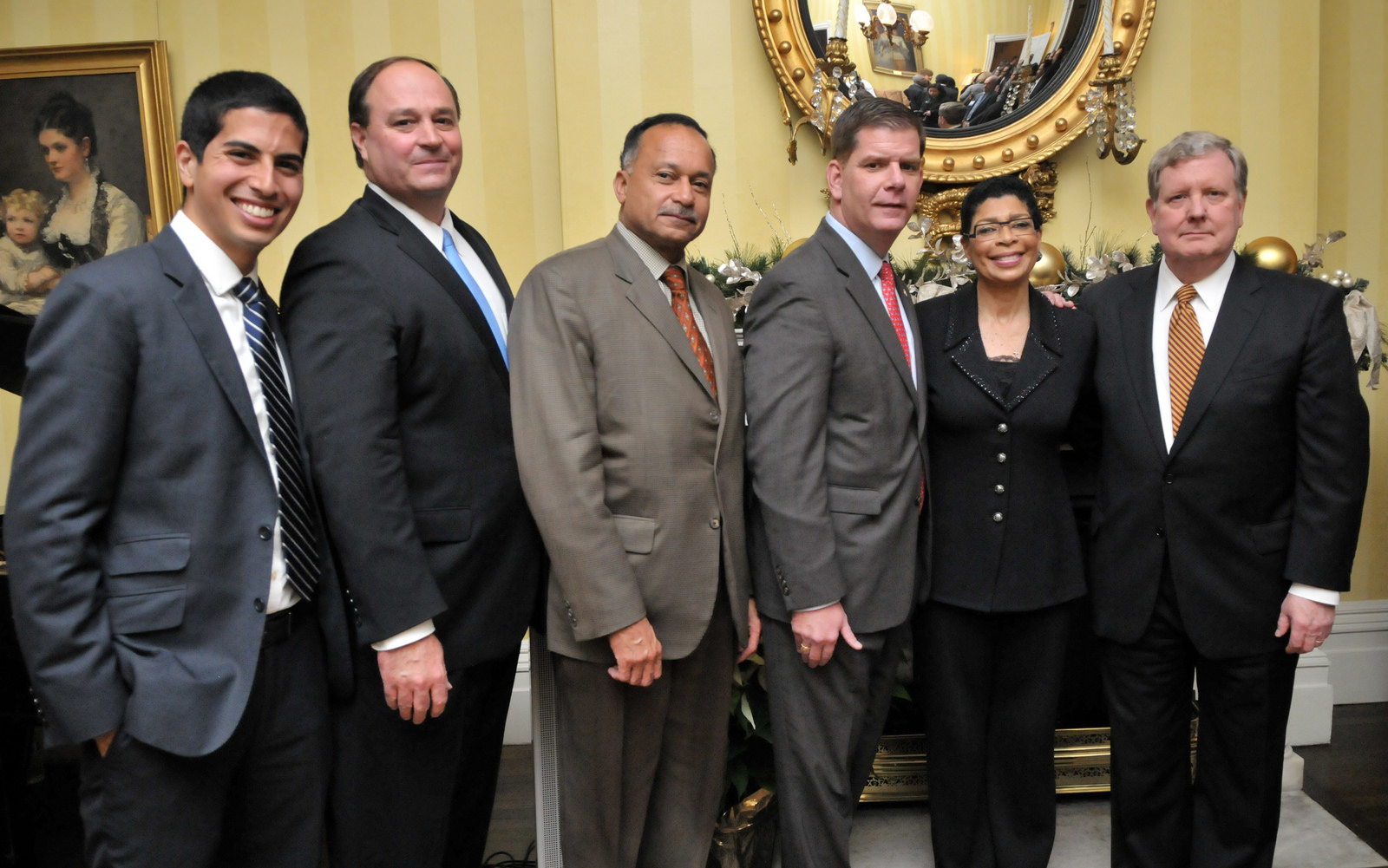
Boston Mayor Martin J. Walsh spoke at the holiday reception C-Suite Conversation, sponsored by John Hancock. Also pictured: Daniel Arrigg Coh, Mayor Walsh’s Chief of Staff; Brooks Tingle, SVP of John Hancock and Board Member; Ralph Martin, Board Chair; Carol Fulp, President and CEO of the Partnership, Inc.; and James Gallagher , EVP John Hancock.
-Lee-Emerson-681x1024.jpg" alt="pelton_dr-lee-emerson" width="340" height="511"> When Martin Luther King was shot down, America lost perhaps its most effective prophet and server of the community.
His commitment to social justice, his struggle for dignity and respect for all people — no matter their circumstances or hues — has made our America a better place to live. His was a message of hope born of a fierce idealism.
His dream — though still unfulfilled — remains, nonetheless, an important American legacy.
However, in the years between his fateful death and today, King’s evolution as social critic has been diminished by the rapid fire and distorting images of television and other media — images that reappear each year during the observation of King’s birthday and of Black History Month.
Today, much of King’s message to America has been reduced to 30-second television images and 15-second sound bites that fail to tell the whole story of his moral and intellectual development.
Who in America has not heard, read, or even memorized parts of the famous King speeches? Best known, perhaps, is the stirring dénouement of his March on Washington address, delivered prayerfully in the shadow of the Lincoln Memorial in August 1963:
“So I say to you, my friends, that even though we must face the difficulties of today and tomorrow, I still have a dream. It is a dream deeply rooted in the American dream that one day this nation will rise up and live out the true meaning of its creed-we hold these truths to be self-evident, that all men are created equal.”
These are powerful and moving words. It is important, however, that we not be lulled by their familiarity into reducing King’s life to static, bite-sized aphorisms. King’s legacy deserves more from us as thinking human beings.
How many of us know, for example, that near the end of his life King had concluded that racism, poverty, and the war in Vietnam were inextricably linked? Or that he argued for a guaranteed annual income for all Americans? Or that he believed that the entire American social and political system should be restructured?
“Now, when I question the whole society,” he said in a speech delivered at the Southern Christian Leadership Conference in August l967, “it means ultimately coming to see that the problem of racism, the problem of economic exploitation, the problem of war are all tied together. These are the triple evils that are interrelated.”
I try to imagine what America would be like today if King — the great champion of social idealism — were still alive, if his influence was not merely a “legacy” or a “dream deferred,” but a living, breathing source of inspiration among us, awakening us daily to the redemptive power of love, to faith in God, and to the promise of a better future.
Were he alive today, he would be 84 years old. I believe that he would still be fighting the good fight for modern-day civil rights: marriage equality, the rights of the sons and daughters of so-called illegal immigrants to attend the colleges of their choice, and stopping the pernicious cradle to incarceration cycle that produces more young black men in prison than in our colleges and universities. He would stir our conscience to be champions for the 99 percent, as the income gap between America’s rich and poor continues to grow. He would be opposed to recent efforts to undo key elements of the 1965 Civil Rights Voting Act. He would be this and much more.
I am always aware that King was struck down in mid-sentence — while he stood talking on the balcony of his second-floor room at the Lorraine Motel in Memphis. His assassin knew what King knew all his life: that in words are found the redemptive power to change, to transform, to transfigure, to persuade, to spur to action, to provide solace, to smooth troubled waters and, yes, to provide hope of a better day.
Let’s not trivialize King. Nor let us permit others to misread him or misuse his words to further their own stingy and narrow-minded political ends.
If we are truly to understand King and give meaning to his sacrifice for a better America, we need to read his speeches, writings and letters-in all of their fullness and complexity.
Let us remind ourselves during our celebration of his brilliant, but too, too short life that we must continue to grow, to challenge our own view of the world and to speak out as King did. Let us add our voices to his call for a committed life. Words were his redemption and they are ours, as well.
A CFO Success Story: Vinay Mehra, CFO of POLITICO , ,
The following is from an interview with jpg" alt="politico-vinay-mehra-executive-vice-president-chief-financial-officer" width="350" height="233"> The following is from an interview with Vinay Mehra. Vinay became CFO of POLITICO in November 2015. Previously, Mehra served as Chief Financial Officer and Treasurer of the PBS/NPR media organization WGBH, as. This interview was edited for clarity. Samuel: You’ve embarked on a new role. Why is this exciting for you?Vinay: The primary reason I came to Politico is because they have built a new business model. I love going into businesses that are creating and inventing new business models. Politico has redefined how to make money in the media business without just being dependent on the advertising side of it. That’s something that really attracted me– they not only created a new business model, but they are also hugely successful in this new business model, and I want to be part of that. Samuel: You’ve had a good long run from your previous experience, in more of a television environment. And now you’re taking that to a new and exciting “new media” environment. What perspectives are you bringing to this new business from your years at WGBH?Vinay: The first thing I can think of is that the most underappreciated skillset in finance is the cost-accounting mindset. The media business is heavily capital intensive. Having to understand the cost is really important. And thanks to my experience in accounting for 10 years, I had alot of clients – manufacturing clients, tech clients – one of the things they taught me was the concept of cost-accounting. Once you have a very good understanding of true cost, and once you can figure out how much of that cost is a standard cost, it make it much easier to manage and scale a business – rather than just focusing top line goals which is just the revenue side of it. And I think what TV broadcasting taught me is – that it is a business which is hugely capital intensive. For example, if we had 5 to 10 million dollars to make a TV show, we would have a very robust cost-accounting system. We would knew down to the penny, and down to an invoice, what everything was being spent on. And for which episode. So taking some of that same discipline is what I inherited from my experiences in the broadcast side of things and brought it into the “new media” side of things. And that was pretty hard to do – because you’ll have journalists writing their stories, and then they’re putting up their stories up on websites, or newspapers. And then you have to figure out how that translates to revenue – which are the stories that are actually driving traffic to the website, which are the stories that are driving revenue. And then figuring out the cost allocation system. So I think that going from old media to new media is where I found the benefit of having the ability to build a true-cost evaluating system. On the revenue side, there is alot more diversity in the revenue field; more in new media than there is in the ‘traditional’ media space. Because the new media companies treat content as information, they don’t treat it as just content. The content that’s on the website should be driven by analytics. And they should decide what really makes sense to put on the website. But more importantly, let’s not just treat it as entertainment, let’s treat it as information. So there’s the mindset of it being an information company instead of being just a media company.
Quick Takes from Vinay Mehra on…What makes a good CFO?CFOs often forget that we are story tellers. And we need to tell a story with the numbers. We need to overlay the non-financial data with the financial data to complete the picture.Underappreciated skillset The most underappreciated skillset in finance is the cost-accounting mindset. Once you have a good understanding of true cost, and once you figure out how much of that is the standard cost, it becomes easier to manage and scale a business. Not-for-profits I find it very fulfilling. One tends to forget, in life, we all have the responsibility to give back to society. Whether it be money, or donating your time and skillset to a needy organization. Working with a millennial workforce This work force wants constant change and they’re not willing to stay with the status quo. Therefore they are constantly adopting new technologies, or adapting to new way of doing things. Importance of good HR The biggest assets here are the people. I really feel that HR is probably the most strategic department of this company. And that is where we have to make the investments. Something to remember The CFO is, in a way, the chief sales person. He is the one who sets the tone of what the organization is doing. He needs to keep providing a positive spin on how the business is doing. To be able to tell people the story even in the worst situation. He not only has to be a fabulous story teller, but also has to be a great sales person.
Samuel: What do you think makes you a good CFO?Vinay: I think there are 2 kinds of CFO – there are CFOs who are very financial focused, and then there are CFOs like myself – CFOs who blend the financial and the non-financial data. What I have found in my career, what has made me successful is the fact that I am able to overlay the non-financial data with the financial data itself. So I can tell a story around what exactly is happening. And in every financial function I’ve had a small group of people doing data analytics. But they’re putting non-financial data and they’re trying to see if it tells a story. I think very often we CFOs forget that we are story tellers. And we need to tell a story with these numbers. Just by looking at the numbers it’s hard to tell a story, unless you have the non-financial information to overlay to show if there is some kind of a trend; or to show what is driving those financial numbers. So I would say that I am very much one of those people who loves to tell the stories behind the financial and the non-financial data. Samuel: I also see that in your career you’ve been very involved in not-for-profits. How has that helped you?Vinay: I think it’s very fulfilling. To be honest with you – one tends to forget, in life, we all have the responsibility to give back to society. And I personally found it very fulfilling to be involved in different causes – to give back to my city, my town, to my local cultural institution. And that’s one thing I would encourage everyone to try to do. It’s less about being on another board, its more about feeling how I’m able to give back. And giving back doesn’t necessarily need to be about giving money – it could be about giving your skillset, and your guidance to these organizations who don’t have allot of sophisticated management skills. They have a mission, and as long as you are in mind with the mission, you can help in many different ways. Helping to make it successful and running it like a business. Even a not-for-profit has to be run like a business and sometimes they lack the skillset. For me it was something very fulfilling, and something I’m glad I got involved with. Samuel: And how did that benefit you? What impact did it have on you as a professional and as a CFO?Vinay: Sometimes, as a CFO, you tend to look at things are pretty black and white. Things are just numbers. But when you get involved with a non-profit, the thing that I’ve come to appreciate is – sometimes, when you are making an investment, you don’t have a true ROI, from a financial perspective. But you will have ROI from a human impact. Or from the bigger benefit of the people, or of this country. For example – when I was in WGBH, very often we needed build TV shows and I would say “hey – no one is ever going to buy this show, no one is ever going to agree to do a big sponsorship for it”. And while that’s true, someone needs to tell the story of lack of diversity, or to tell the story of some other area which nobody else is willing to put the money in to do, because they don’t see the financial ROI on it. But we have a responsibility to tell that story. So we’ll spend money on it because that’s really our core mission is – to educate people. So I would say it’s given me the appreciation to understand that sometimes in business you will make an investment in something that may not have a true ROI, but there will be other ways to measure ROI beyond the financial terms of things. Samuel: What was most surprising for you when you showed up at Politico?Vinay: The energy and the passion around their mission of providing political information to their audiences. They are all uniformly passionate about this subject. You know, it’s not often you walk into a business where everybody – from the administrative assistants, to the help in the kitchen – are all uniformly passionate about this stuff. It’s amazing. And it make everything alot easier, because everyone is aligned with the mission. Everybody is very passionate about what difference they want to make. And the second thing – which came as a bit of a surprise for me – was the millennium demographic, which is a large proportion of our employee base – between 25 to 28. They’re working at a much faster pace than you or I do! And I love working fast and changing things, but this work force wants constant change and they’re not willing to stay with the status quo. Therefore they are constantly adopting new technologies, or adapting to new way of things. And they crave it, and they keep pushing for it. This has been a big surprise for me, coming from big corporations where change is so hard, and it’s so hard to get people on board, or to follow new ways of doing things. Samuel: It must be a big change, coming from NPR-type of background, where you were truly middle-aged, taking a look at everyone around you. Coming from an environment where you were one of the younger ones, to an environment where you’re one of the older ones.Vinay: Yes – and the other thing is I think their desire and energy for staying in the forefront of technology and processes – it’s in their DNA. You don’t have to tell these people – they live this every day – how can we do things better. They’re built this way. And I think some of it is maybe because you don’t have the luggage of a traditional media company and all the headaches of running a traditional media company. But this is a company that continues to innovate every day. In every way – from how to come up with new revenue ways, to how can we become more efficient to how to use new technology. It’s just blowing me away. And it’s very refreshing to be an environment like this. Samuel: And how does that translate for your finance team?Vinay: That’s where I would say I have work to do. Because the rest of the organization is so forward thinking that my finance team hasn’t kept pace, with their level of change. In some ways I think the finance team got comfortable with the old ways of doing things. As if it’s the only way to be doing things Samuel: So what are you doing to put change into a finance group that needs to be changed a little bit?Vinay: The first thing I’ve done is to physically relocate people from my finance team into business groups. The people who do invoicing and billings and collection for my ad business used to sit in finance, in a central location, and I’ve taken them out of there and said go sit in the unit. Go sit in the business. Go see what they do every day and be part of their workflow, instead of sitting separated on a different floor and communicating through emails. I think that’s given them a sense of appreciation how the business operated, that they never knew before. Secondly, substituting some of the skill sets that are lacking on the team, I bring in new people. For instance, somebody with more experience and or somebody who is an expert in certain areas is going to have expertise in their DNA of the finance function and will be able to figure it out as they go along. Which works to a certain point, but then a lack of knowledge and a lack of expertise because of the hindrance. And the third thing is technology. They are very advanced with leveraging and using technology here. And because of that, the business units have gone off and made selections of technology products to streamline their operations and their processes. And on the back end of things you have finance working on QuickBooks because they haven’t kept pace with the evolution and change that has happened in the business. Samuel: What are you ultimately responsible for, at Politico?Vinay: I have Finance, I have HR, and I have Operations. I have pretty much ALL the business operations of the business. Basically all the non-editorial side of things. Samuel: Have you always had HR responsibility?Vinay: I have. In different forms. In WGBH I had business managers in HRO sitting in the business units, who reported to me. So yes, I’ve always had some HR responsibility. Planning, strategy, all those groups reported up to me Samuel: How does it feel to be responsible for human resources in an environment that’s growing, dynamic and where culture is a key part of the talent pool?Vinay: To be honest – the biggest assets here are the people. They don’t really have any physical assets here. And so preserving that asset base is extremely critical, for the organization. And we are thinking about additional approaches – until now we took for granted that we’ll have 20-30% turnover and keep hiring new people. My philosophy is we need to find a better way of keeping this from happening instead of constantly dealing with this turnover. And I get excited about the fact that I can help influence and be a caretaker of the culture of the organization. I feel that it’s a great opportunity for the organization to be able get what they are looking for, from a cultural perspective. Sometimes I feel that an HR reports directly to the CEO of an organization, and they tend to take a more of an administrative function. I really feel that HR is very strategic and probably is the most strategic department of this company. And we have to make the investments here. This is where we need to put the most focus – to help make sure that we can keep our employees. Samuel: What advice would you give to someone in finance that’s trying to work their way up and wants to become successful in their career? Advice that you wish someone would have told you?Vinay: I would say that having an understanding of the numbers and the context of the business, the strategy of the business is extremely critical in this day and age to be a successful CFO. Early in my career, when I was in accounting, I think the reason why I was so successful with my clients is because I was able to focus on their business problems, not just their financial problems. Additionally, in some ways the CFO is also kind of the chief sales person. He is the one who sets the tone of what the organization is doing. He needs to keep providing a positive spin on how the business is doing. To be able to tell people the story even in the worst situation. And so what tends to sometimes happen is that we forget that we have the DNA of a sales-person. We need to use that. Whether we are talking to our salary employees, or if we’re talking in external shareholders or investors. And I feel that anyone who wants to grow their career in a finance perspective, not only has to be a fabulous story teller, but also has to be a sales person. +++++++ A CFO Success Story is a feature of Samuel’s CFO Blog, where Samuel Dergel follows up on his book, Guide to CFO Success, speaking with CFOs featured in CFO Moves and CFO Moves Canada, Samuel’s popular and comprehensive weekly report on CFO Movement across the USA and Canada. Read more > Read less
Freedom Bound , ,
Few societies in modern history have been more invested in the social construct of race than the United States.
jpg" alt="rougeau_vincent-boston-college" width="252" height="288"> Few societies in modern history have been more invested in the social construct of race than the United States. The perpetuation of race-based chattel slavery in a nation founded on radical notions of individual freedom fueled enduring, albeit simplistic, dualities around the concepts of “black” and “white” in American law and culture. Although a gruesome civil war ended the legal institution of slavery, it was not enough to prevent the ongoing political and social marginalization of those of “traceable” African descent. Our obsession with race has been at the root of some of the most shameful incidents in our history, but it has also led to some of our greatest triumphs in response. One of those triumphant events occurred 50 years ago this summer, when the U.S. Congress passed the Civil Rights Act of 1964. Although designed to address more than racial discrimination, the act is seen as a great triumph of the civil rights movement and the effort to end discrimination against black people in the United States. The legislation helped complete the transformation of the United States from a parochial, self-involved nation to the pre-eminent global power it is today.
Facing Discrimination
Fifty years is a long time in a human life—an entire life in my case—so it is becoming increasingly difficult for people alive today to imagine what the United States was like prior to 1964. For those who do remember, the changes unleashed by the Civil Rights Act were extraordinary and were part of a period of jarring cultural and legal change.
Prior to 1964, racial discrimination and racial segregation were habitual and ingrained parts of life for most Americans. Although the U.S. Supreme Court had outlawed racial segregation in public schools in 1954, there continued to be widespread resistance to that ruling in the early 1960s and for many years thereafter, in both the North and the South. Segregation was still the norm in most other areas of life, both implicitly and explicitly.
In the mid-1950s, my grandfather and his brothers migrated to the oil towns of south Louisiana from the surrounding rural civil parishes to satisfy the growing need for low-skilled and semi-skilled labor. On payday, they would make their way to the oil refinery to collect their wages. On some days they would be paid right away. At other times they would spend the entire day watching while every white person at the plant was called into the office to be paid, which often meant that they did not get their money until the end of the day. These practices were part of the everyday indignities of being black in the United States, hardly worth remarking upon for many of those who suffered them despite the inconvenience and humiliation they caused, and not unlike certain types of indignities often suffered by undocumented migrants today. Marginalization and powerlessness make one easy prey for casual acts of cruelty, both petty and severe.
By the early 1960s, it was clear that how Americans thought about race was changing, but real change would still be a long time coming. In 1961, my wife’s father became one of the first black engineers hired by Bell Labs. He was hazed relentlessly upon his arrival—garbage was dumped on his chair and effigies swung routinely from his desk lamp. Meantime, he and his wife struggled to find a decent place to live until my mother-in-law took matters into her own hands. Apartment hunting on her own, her olive skin and long, brown hair announced a suitable tenant for an apartment in the affluent town of Summit, N.J., where they ultimately settled and where my wife spent her early years. Nevertheless, buying a home there proved very difficult—my mother-in-law could not buy a home by herself—and they ultimately settled in a more diverse but increasingly segregated and declining city nearby. Like so many other black professionals of their era, if they wanted to live in a community that offered them some measure of acceptance, they were denied an opportunity to build wealth through their investment in their homes, which often lost value as their neighborhoods become more segregated over time.
The Civil Rights Act became the catalyst for a torrent of legislation designed to promote racial and gender equality, fair housing and pay equity, but when one looks back over the history of the last 50 years, what is particularly conspicuous is how long it took for real change to take root, and how often much of it was due to extraneous factors like economic change, immigration and, more prosaically, the passage of time. What is equally striking, however, is what appears on the horizon. Although it may be too early to call the United States a post-racial nation, clearly the emergence of that type of society is well underway.
Exceptional History
Despite the pervasiveness of race as a driving feature of our history, Americans are very uncomfortable embracing and owning that history as a communal story integral to our shared identity. Many people often bend over backward to pretend that they do not see race in everyday life—how many times has someone been described in excruciating detail before we are told that he or she is black?—although they typically are very comfortable acknowledging the corrosive ongoing effects of racism institutionally and structurally. Others tend to insist that American racism was simply an unfortunate aberration from the nation’s glorious founding story. Many insist that race no longer matters and resist even modest efforts to offer redress for America’s racist past. That is unfortunate, because we also have some victories over our racial demons that are well worth celebrating, and these moments in our history signify some singular accomplishments of the American experiment.
The United States was not unique in its creation and maintenance of an underclass, although few nations are so quick to assign an exceptional status to themselves that would suggest otherwise. Not long ago, in his commencement speech at West Point, President Obama declared that he believed, “with every fiber of [his] being,” in American exceptionalism and that the United States remains the one “indispensable” nation. The Civil Rights Act was certainly a moment of exceptional self-awareness for the United States, and it is almost impossible to imagine such sweeping legislation being passed today. But the United States also had a remarkable attachment to the institution of slavery, long after most other societies had ended the practice, and it took a shockingly brutal civil war to end slavery here. After the war, we maintained a highly effective system of racial segregation through both legal and extra-legal means for another 100 years. All of this marks the United States as exceptional—and perhaps not so indispensable—but not in ways that we generally want to talk about.
But over the last decade or so, there is a growing sense among many Americans that something fundamental has changed in the way we understand race. We have an African-American president who had a white, American mother and Kenyan father. The fastest growing racial category on the U.S. census is now “mixed race,” and suddenly the black/white duality that was so much a part of the American consciousness has begun to sound stilted and anachronistic. In metropolitan Boston, where I live, the black population is growing rapidly because of immigration from Africa, the Caribbean and Latin America. Many of these immigrants reject the American black/white dichotomy, and many want nothing to do with the term “African-American.” In my own family, most of my children’s first cousins are part of multiracial families, and I expect this to continue as I watch my children date and prepare to select their life partners.
The Next Struggle
Although it is important to honor the past as we celebrate 50 years of the Civil Rights Act, it is also essential that we consider the future. How will we understand race and racial discrimination in an increasingly multicultural America? The descendants of slaves in the United States still find themselves disproportionately represented in negative statistics about poverty, education, single-parenting, wealth creation and life expectancy. Discrimination and racism still rear their heads on a regular basis. The president has been the victim of a stunning effort by the Republican Party to make it almost impossible for him to govern, and we routinely hear statements from Republican legislators that make it clear they would rather see the government grind to a halt than work with Barack Obama. We have even been treated to the shocking indignity of the president being heckled by a member of Congress during a State of the Union address. Yes, I think a lot of that is about race, but how much longer can angry white men (for the most part) from gerrymandered districts ignore America’s multiracial reality and the long-term challenge this will present to politics in our democracy?
As someone whose possibilities in life were transformed by the Civil Rights Act, I am deeply indebted to the men and women in the civil rights movement and in the government who had the courage and vision to make it a reality. But looking ahead, I will welcome an America that will no longer be cast in black and white. I am encouraged by the young men and women I meet from places like Ghana, Nigeria, the Dominican Republic, Haiti and Brazil who have pushed Americans toward a richer and more global understanding of black identity. I celebrate immigration from Latin America, Asia and elsewhere, which has been instrumental in making our cities more cosmopolitan, vibrant and welcoming.
In many ways, the treatment of immigrants is emerging as a new civil rights issue, and it raises a number of concerns around exclusion, membership and participation in a democratic society that characterized the civil rights movement in the mid-20th century. These issues should have particular resonance for Catholics because our social teaching takes a very strong position in support of social inclusion for the poor and the stranger. As Congress devours resources of time and money to accomplish little of lasting value when it comes to immigration, their inaction and indifference should announce an opportunity for the rest of us to act in a way that honors the legacy of the Civil Rights Act.
Immigration is no more a threat to the United States than was letting black people compete for jobs on an equal footing or buy houses where they wanted. Treating people with dignity regardless of the color of their skin, their gender, sexual orientation or national origin does involve letting go of long-held prejudices, and it does require change. Embracing the possibilities and opportunities that will come with a more humane system of immigration in this country will allow us to recognize the reality of a change that is already underway and offers hope to our children and grandchildren that the multicultural America that is emerging around them will be a place of hope, opportunity and strength, as opposed to an angry fortress of fear.
There was a lot of fear back in 1964, and overcoming centuries of racial discrimination in this country is still a work in progress. But we are at our best as a society when we are open to the possibilities of the many and when we look beyond ourselves to see God in the face of the other. Celebrating the Civil Rights Act allows us to remember a very difficult period in our shared history and reminds us how far we have moved beyond it. It also recalls the decency and vision of those who came before us who knew that this nation could be better. Developing a humane, fair immigration policy would be one more step toward reaching that goal—and a fitting way to honor the legacy of the Civil Rights Act in a nation that is quickly moving beyond black and white.





 -Lee-Emerson-681x1024.jpg" alt="pelton_dr-lee-emerson" width="340" height="511"> When Martin Luther King was shot down, America lost perhaps its most effective prophet and server of the community.
